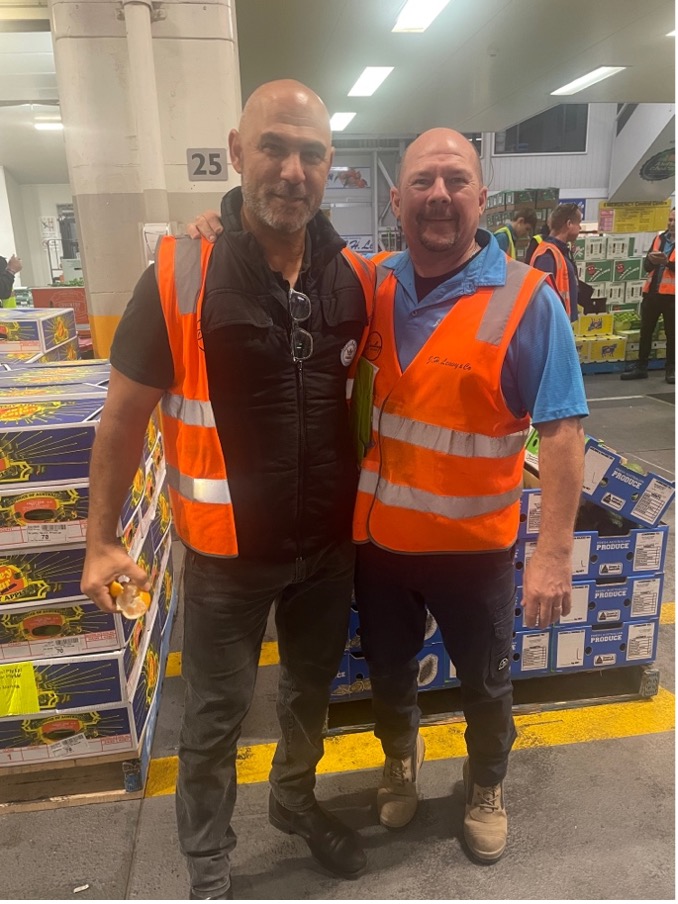
The rising cost of living is affecting only customers as local wholesalers are benefitting off the demand for produce.
Christopher Mizzen, Vegetable sales manager for J.H Leavy & Co in the Brisbane Produce Market, has noticed a large increase in expenses over his thirty years of service.
“At the moment we are transferring 96 cartons for $600 a pallet from Western Australia to Queensland,” Mizzen said.
“When I first started in the business it costed around $400 a pallet to transfer freight.”
“During COVID labour got expensive. No one could work so the cost of produce just went up.”
“Even during the 2022 floods lettuce went from $14 a carton to $100 because the Gatton region got wiped out,” he said.
COVID-19 and recent floods have made the Consumer Price Index rise by 5.1% between March 2021 to March 2022. This rise was the highest annual rise reported since the introduction of taxation in 2000 as documented by the Australian Bureau of Statistics.
This price inflation has been perceived as a worry for middle-class citizens who are relying on Brisbane wholesalers to supply their produce.
Although Mizzen has experienced an influx in freight costs, he profits off loyal customers like Samuel Nicolaou, current storeowner of Chris’ IGA Carina.
Nicolaou has seen a vast change in the price of produce over his lifetime as the son of the former storeowner, with weather-affected produce being a large contributing factor to price inflation.
“If there’s been too much rain, the produce can’t get picked. They (produce pickers) cannot physically get out there,” Nicolaou said.
“Then there’s the flow and effect of excess rain damaging the crop and then you have very little being picked which corresponds to a higher price.”
“The staffing cost definitely affected the fruit pickers, the packers, everything along the line of fruit and veg’,” he claimed.
Likewise to Nicolaou, Savva Efthimiou, store manager of Harris Farm Clayfield, noticed that despite the influx in produce prices during COVID lockdowns customers were still willing to splurge.
“Due to lack of labour, you couldn’t get the stock so prices were just inflated by 100-200% in some cases,” Mr Efthimiou said.
“And people were still paying because that’s all they could do, just shop.”
“I think what happened with the lockdowns was that people got into a certain habit and I think they went back to basics and realised that ‘you know what? this is good!’ because for a while there business was shit.”
“A lot of shops were struggling and all of sudden when it hit, everything sort of went boom and stayed there,” he said.
Mr Efthimiou said that the COVID lockdowns brought more customers to Harris Farm Clayfield with the consequence of higher prices.
Both retailers have highlighted the dependence seasonal produce has on the changing market.
“The cheaper it is reflects the amount of produce on the market. In a couple weeks’ time strawberries will be predominantly from Queensland and if the weathers been good, they will be cheap,” Nicolaou stated.
“If there’s a demand for that item, the price won’t come down. The market is influenced by the demand,” Efthimiou claimed.
With the arrival of winter produce in Queensland, summer produce imported from America is predicted to come at a cost for middle-class workers.