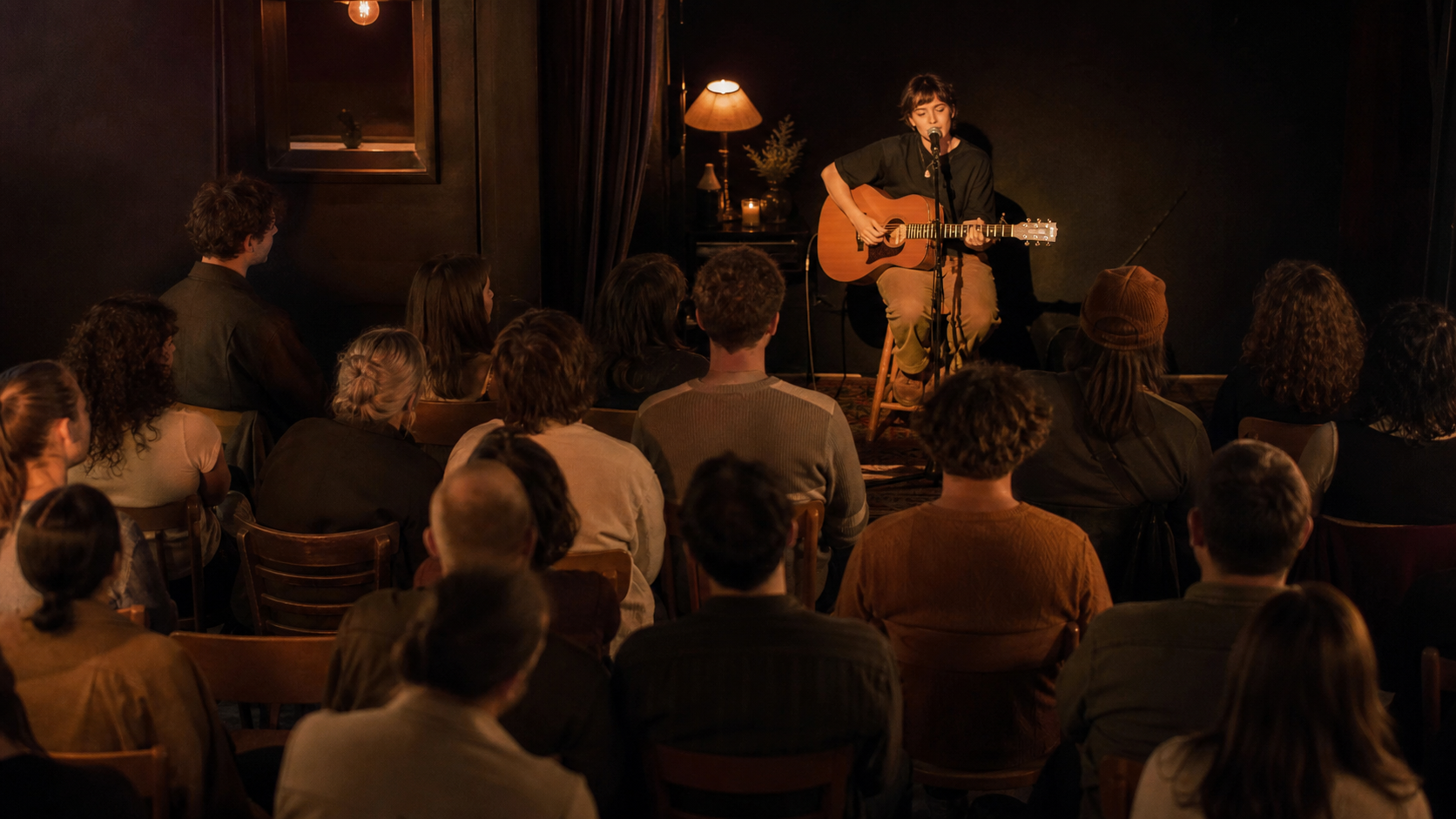
The room goes quiet before the first chord. There is no clatter from a bar at the back, no conversation competing with the monitors and no glowing wall of phones held above the crowd. For the next hour, the agreement is simple: everyone has come to listen.
That agreement is at the centre of a growing number of listening rooms—small venues built around close attention rather than spectacle. Some occupy old shopfronts, galleries or community halls. Others appear for a single night in bookstores and rehearsal spaces. Their stages are usually low, their sound systems modest and their audiences close enough to notice a singer take a breath.
A different kind of night out
The format is not new. Folk clubs, jazz rooms and house concerts have long treated silence as part of a performance. What feels different now is the range of musicians and listeners embracing the idea. Electronic artists are adapting arrangements for seated crowds. Rock songwriters are stripping songs back to voice and guitar. Listeners accustomed to festivals and arena tours are making space for something smaller.
The appeal is partly practical. A quiet room allows an artist to play softly without losing the song beneath audience noise. It can also reduce the amount of equipment needed to make a show feel substantial. But the real distinction is emotional. Details that disappear in a busy venue—a lyric delivered just behind the beat, a finger sliding along a string, a piano pedal lifting—become the event itself.
A listening room does not make music more important. It simply removes the distractions that tell us it is not.
For audiences, that attention can feel unusually generous. The performer is not background music for a conversation, and the listener is not one face in a moving crowd. Both sides accept a little vulnerability. A quiet song has nowhere to hide, and neither does a restless audience.
Small scale, lasting impact
Listening rooms face the same pressures as other independent venues. Rent, staffing and artist fees do not shrink simply because the capacity does. Operators often rely on advance tickets, memberships or partnerships with local businesses to make the numbers work. A sold-out room may still contain fewer people than the queue for a larger venue.
Yet small scale can be an advantage. Artists meet listeners after the show. Regular audiences learn to trust unfamiliar names on a program. Promoters can take chances on musicians who are still developing an audience, because the room itself has become part of the draw.
The result is less a reaction against loud concerts than an expansion of what a night of live music can be. There will always be songs made for movement, singalongs and towering speakers. Listening rooms make a parallel case: that sometimes the most memorable performance is the one quiet enough to pull an entire room closer.